|
Wolcott Historical Society News - March 2026
By Florence Goodman
This month's article will introduce to you, two more soldiers from Farmingbury settlement who volunteered to serve in the fight for our country's freedom. Many of them shared their stories of life of a soldier in letters or journals, which eventually found their way back home. The following stories were found in the journals of Josiah Atkins and Judah Frisbie.
Josiah Atkins was born in 1749 in the part of Farmington, which later became Bristol. In 1759 his family moved to Farmingbury Parish. From 1770 to 1772 he taught school in Farmington. He had a blacksmith shop and served as a dentist in Farmingbury. In January 1781, at the age of 31 he enlisted in the Continental Army. The following is from his journal.
"On the 5th day of April following we marched to join the army at Highlands New York where I was joined with Col. Sherman's regiment in Capt. Benton's Company. Our business at present is to learn the military art. Provisions are good beef and bread. On May 15th I set out, which is very unexpected, to join the Infantry down at the Southland."
He went on to say that they marched for 10 days to Philadelphia and then to Virginia. His June 6th and 8th entries talk about passing through Gen. Washington's plantation, marching 10 miles on his land and marching through great wilderness. On June 10th they meet up with the Marquis de Lafayette and continued marching through wilderness with no water. All were very thirsty.
Josiah's July entries tell of the discouraging battles against the British but also tell of the bravery of Lafayette and how two horses were shot from beneath him. By August the troops were marching toward Yorktown and the sick towards Hanover.
He was among the sick and writes, "I am present among invalids unfit for duty, but Providence has ordered it as to make me instrumental of some good to my country - at least to my fellow soldiers - which is by letting blood and drawing teeth. The last I practice very much there being not another tooth drawer in the whole army- and the other considerable for few doctors have tools to let blood."" (Bloodletting was thought to relieve fever and other ailments in those days.)
This was also written in Josiah Atkins journal: "My dear Friends and Fellow Soldiers: As we are engaged in a bloody war, the fate of which is uncertain; as we are drawing near the enemy and expect nothing but fighting; as in any action some may fall; and as my life is uncertain as any others; so should it be my fate to drop and yours to survive you may chance to light on this little book and its contents, with the other things I may happen to have about me which 'tis probable will be a watch, a pair of silver shoe buckles, stock buckle, stone sleeve buttons and perhaps some money. These, I freely give you. Yea, I bid you welcome to them on your engaging to grant me this request - to use your utmost endeavor to send this book and its contents to my dear wife, whom I have left home to mourn my misfortuneÉ You may think this of small importance; however, you must suppose that it will be satisfactory to her (on whose account it was written) to hear my fate." He goes on to tell how to get the book to his wife. Josiah Atkins died in service, in Virginia on October 26 or 27, 1781 after serving for only 10 months.
Judah Frisbie was born in Branford, Connecticut on September 12, 1744. He was the second of eight children born to Elijah and Abigail (Culver) Frisbie who settled in the Waterbury area in 1750. The Frisbie family moved to the Woodtick area of Farmingbury in 1759. Judah settled there in December of 1773 on four acres of farmland. Judah built his first home, a small frame structure or a log house around 1776. After his marriage to Hannah Baldwin of Bucks Hill on August 12, 1779, he built a larger home, which stood until 1872. That house would later be replaced with another home built by David Frisbie, Judah's great-grandson. Judah and Hannah had four children. Judah kept journals or account books where he recorded his personal records of money he earned or spent as well as of his Revolutionary War days. From his journals it was noted that he operated a sawmill on the site below the dam on Nichols Road and a turning mill located on Lily Brook. He also manufactured wooden roof shingles and metal buttons of various sizes. He usually paid his debts in labor or with the materials he produced.
Judah was a Patriot serving in the military for two short enlistments. The following paragraph details some of the events from that time. On June 1, 1775, his company set out from Waterbury for New York. They marched an average of thirteen miles a day until they reached Old Fairfield on June 3rd. They camped there for three weeks guarding the State house and the battery. On June 24th and 25th they continued marching until they joined General Woster's and Colonel Waterbury's regiments in New Rochelle. They set out early on the 27th passing General Washington's regiment. On June 28th they reached the city of New York and took shelter in barns because of stormy weather. They camped in this area for three weeks and then marched on to Albany and Canada. At this point Judah was sent back to New York on his own to take care of a sick soldier that they had left to recover, but he ended up sick as well and was hospitalized. Once recovered Judah joined his own regiment on Long Island in pursuit of "regulars" that were robbing inhabitants of their cattle, sheep, etc. They spent July, August and September in this area protecting the coastal region. At the end of September, they sailed for Albany then on to Saratoga and Lake George and finally Lake Champlain. On October 27th and 28th just below St. Johns they were fired upon but had no causalities and were later assisted by the French. For two days and three nights they had bombs, cannon balls and grapeshot fired at them. It wasn't until November 3rd that the regulars surrendered and they were able to take possession of them. Judah saw many more battles during this time, but finally his regiment worked its way south through Vermont, Massachusetts and finally back to Farmingbury, on December 13, 1775. Judah's second enlistment was not until August 12, 1777, and his journal entries stop on September 8, 1777. He marched with Ensign Gaylord and 12 men from Farmingbury to Wallingford and were joined by Lieutenant Peck. They arrived in New York on August 14 and trained there for almost a week and then went on to Fort Lee. His last journal entries were from September 5th and 8th explaining that two soldiers had died from distemper." Judah Frisbie died in Wolcott, Connecticut on January 27, 1817, at the age of 72 after a short illness. He is buried in Woodtick Cemetery in Wolcott.
Patriots, Josiah Atkins and Judah Frisbie were two more examples of the strong-minded men from Farmingbury Parish who served their town and country without hesitation.
(Information for this article was taken from two brochures: one from the Wolcott Historical Society titled, "WOLCOTT In The French and Indian Wars, The Revolutionary War and The War Of The Rebellion" and the second "The Journal of Josiah Atkins of Waterbury Farmingbury Society In Ye State of Connecticut N. England 1781" printed by the Mattatuck Historical Society, Waterbury, Number 21. October 1954; the "1986 Historic Resources Inventory," by J.P.Loether Associates; "History of the Town of Wolcott (Connecticut) from 1731 to 1874," by Samuel Orcutt; and hours of research by Deb DuBois on Ancestry.com, Newspapers.com and other online research sites; a talk given by Florence Goodman, for Patriots' Day 2017; "The Journal of Judah Frisbie, A Soldier of the Revolution" by Judah Frisbie and compiled by The Mattatuck Historical Society, 1943; Woodtick Cemetery records)
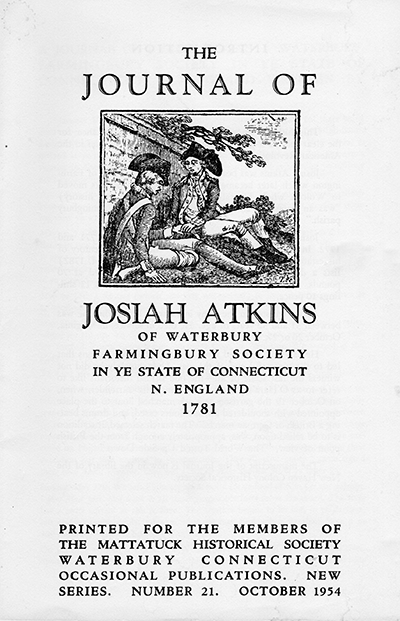
Journal of Josiah Atkins reprinted by the Mattatuck Historical Society.
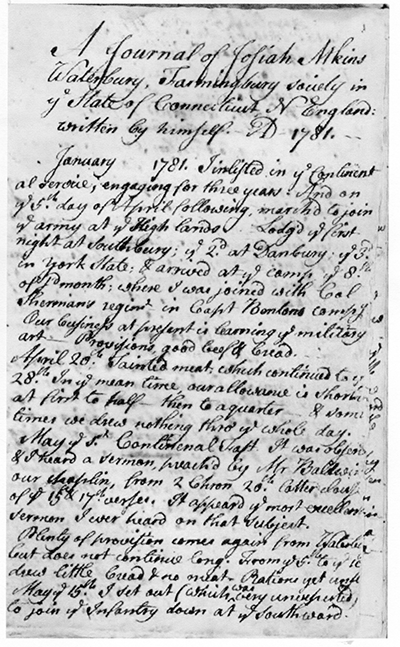
Copy of the original Atkins's journal page.
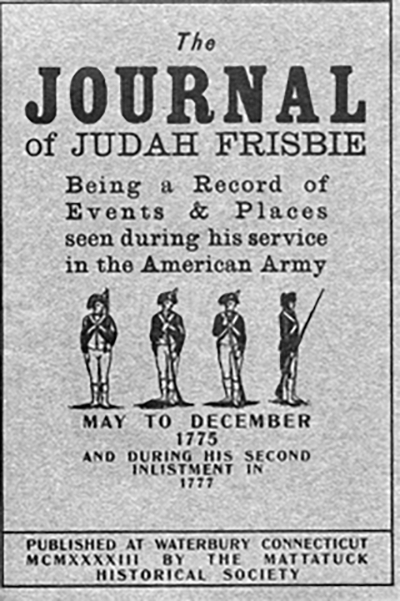
Cover of Judah Frisbie's journal reprinted in 1943.
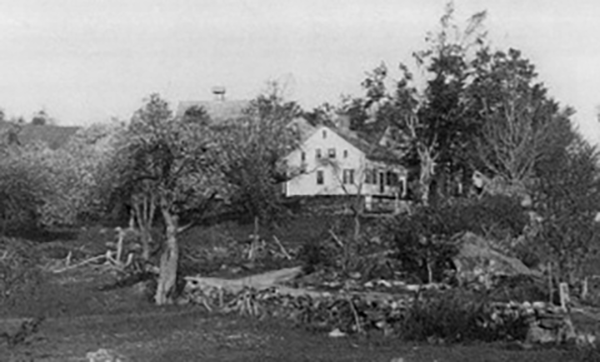
The Josiah Atkins House at 49 Center Street. Built for Josiah Atkins in 1777.
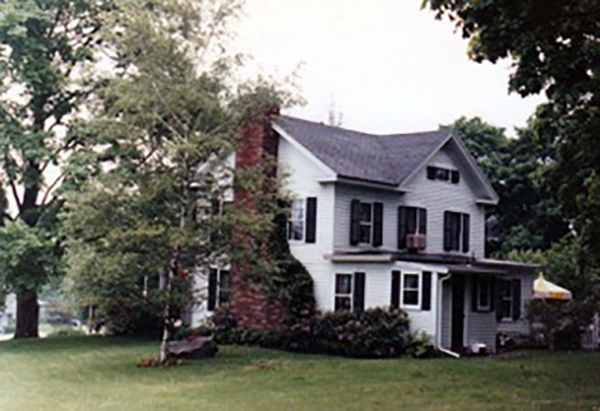
David Frisbie or Berkley Frisbie House at 435 Woodtick Road built in 1837 by Judah's great grandson.
To view past installments of the Historical Society News, click here.
|