|
Wolcott Historical Society News - January 2026
By Florence Goodman
This year marks 250 years since our country declared its independence. Although our town was not incorporated as the Town of Wolcott until 1796, the parish of Farmingbury sent 102 militiamen between the ages of 15 to 50 over the course of the American Revolution. These early settlers were willing to fight for independence despite the small size of their settlement because they knew firsthand what the struggles for independence meant. They also worked diligently to supply provisions to the Continental armies, and especially to the thousands of troops who camped or traveled through the roads of Farmingbury under the leadership of Lafayette in 1778 and Rochambeau in 1780.
So, what did the small settlement of Farmingbury look like in those early years? It held winding, rough roads that worked their way through the wooded hills of the town. Thomas Judd, an early settler, made his way up Southington Mountain and built a small house on or near the present junction of Farview Avenue and Meriden Road in 1690. He later moved to Waterbury and the house, and land was then inhabited by his daughter Ruth and her husband, Thomas Upson. In 1731John Alcott (Alcox) a fourth generation, purchased 117.5 acres of land on Spindle Hill. John was only 26 years old at the time. He erected a small cabin on the property at the corner of Beach and Spindle Hill Roads. This cabin which is no longer standing is where John's wife, Deborah gave birth to their son John Jr. Their son was the first person of European descent known to have been born in the settlement. John Jr. a fifth generation of Alcott's married Mary Chatfield of Derby, and they built a house on Spindle Hill. They had nine children. Their son Joseph, born in 1771 married Anna Bronson in 1796. In 1805 they settled on Clinton Hill or "New Connecticut" the highest land in the Spindle Hill district. Amos Bronson Alcott was their second child. He grew up on that land and wrote about its beauty in his book called "New Connecticut." He stated that on a clear day one could see Long Island Sound from that hill.
Farmingbury's original burying ground, the Edgewood Cemetery was established in 1764. The land for the town green was designated in 1770, and the original Congregational Church was built in 1772. This early settlement continued to grow over the next few decades. Some of the families to settle in the early 1800s were Frisbie, Grilley, Benham, Byington, Talmadge, Tuttle, Barnes, Thomas and Atkins. Those strong families braved the harsh winters and short summers to write the early history of our town. Over the course of the next year, I hope to introduce to you to some of the people who helped to develop our town's history.
This month, I'd like to start with James Thomas, and the house he built 250 years ago on Spindle Hill. In those early days Spindle Hill Road wove its way from Waterbury to what today is called Bristol. It is believed to be the oldest road in our town. The Thomas house is located on Peterson Lane, a dead-end road off Mad River Road. It was first named Bryant Road after the family farm located there, but in 1918 Carl and Helma Peterson purchased 150 acres of land along Spindle Hill and Mad River Roads which also included the James Thomas house. They changed the name to Peterson Lane, and the Thomas house remains there today.
James Thomas, a cooper by trade came from Scotland in the late 1700's and settled in Farmingbury. He built this one and a half story Cape Cod style, post, and beam home in 1775 on Spindle Hill. He and his wife (Martha Barnes) had seven children. Seth was the fifth child born in this house in 1785 and lived there until about 1810.
Although James Thomas was trained in repairing casks and barrels, he loved carpentry, and this skill was passed on to Seth who had a natural ability for it. Seth had a limited formal education, and at an early age left school to become a carpenter's apprentice to Daniel Tuttle, of Plymouth. Seth exhibited great energy and perseverance in all that he did; thus, he paid strong attention to the duties of his apprenticeship. On completion of this apprenticeship, he became a skillful woodworker and worked building houses and barns in the nearby towns around Farmingbury.
In the early 1800s, Seth attempted to set up a clock-making industry in Wolcott; he made his first clock here. The woods around the family house were filled with mountain laurel trees used in the production of his clocks. Many Wolcott men worked cutting the trees and sawing them into thin slices, which, when seasoned, were used for the gears of the clocks. The women of the town spun flax into cords that were used to hold the clock weights. So, the town of Wolcott profited from Seth Thomas's enterprise, while he lived in town and even when he moved his business out of town.
In 1807, Seth joined Eli Terry and Silas Hoadley in a business in Plymouth making clocks at a wholesale rate. Seth mainly worked on fitting the wheels and different clock parts together. From 1807 until 1810, they made 4000 clocks of the "hang-up" or "wag-on-the wall" type. These clocks did not have cases, but buyers who wanted cases for their clocks hired carpenters to build what they called "grandfather cases" for them.
Around 1810 he made an offer to Mr. Daniel Byington to purchase mill property on the Mad River at the junction of Center Street and Wolcott Road. This millpond was located where Pat's IGA parking lot is today. It was believed that the waterpower of Wolcott was superior to that of Plymouth Hollow and this site would have made an excellent location for his mill. He also asked the town to open a road direct to Cheshire for the export of his manufactured goods, but the town declined his offer. This was one of Wolcott's most significant missed industrial opportunities during the early 19th century. If they had agreed to his offer, our town would have reaped the benefits of the Seth Thomas Clock factory.
Soon after, Thomas and Hoadley bought out Terry's share of the company and worked together until 1812. At that time Seth Thomas sold out his share of the company to Hoadley and went into business on his own in Plymouth Hollow. In time, Seth Thomas built a mill for rolling brass and making wire that he operated in conjunction with his clock factory. It wasn't until 1853 that the Seth Thomas Clock Company was established. Thomas also purchased the manufacturing rights of the shelf clock from Eli Terry and turned this type of clock into a big seller. He mass-produced clocks by using automated methods to build and assemble the components of the clocks.
Seth's first wife was Philinda Tuttle; they married in the early 1800's and had a daughter, Philinda. After his first wife's death, he married Laura A. Andrews. They had six children Seth, Martha, Amanda, Edward, Elizabeth, and Aaron. Seth Thomas, Jr. went into the clock business with his father. It was Seth Jr., who enlarged the clock factory and developed it into a world business. Seth Thomas died in 1859 in Plymouth. At that time the politicians of Plymouth designated the western portion of the town, where the factory was located, as Thomaston in his honor.
(Information from this article was taken from the "1986 Historic Resources Inventory by J.P.Loether Associates; History of the Town of Wolcott (Connecticut) from 1731 to 1874 by Samuel Orcutt; and an article written in 2019 by Florence Goodman about Seth Thomas.)
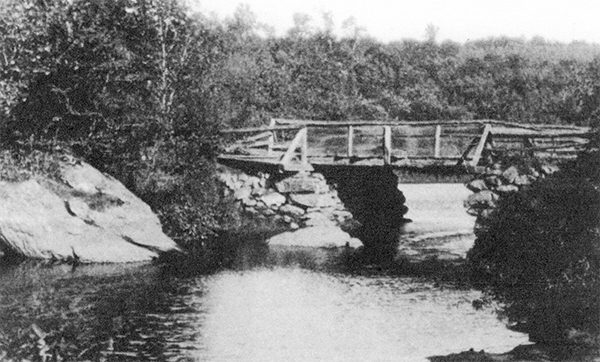
Center Street bridge circa 1900 at the corner of Wolcott Road.
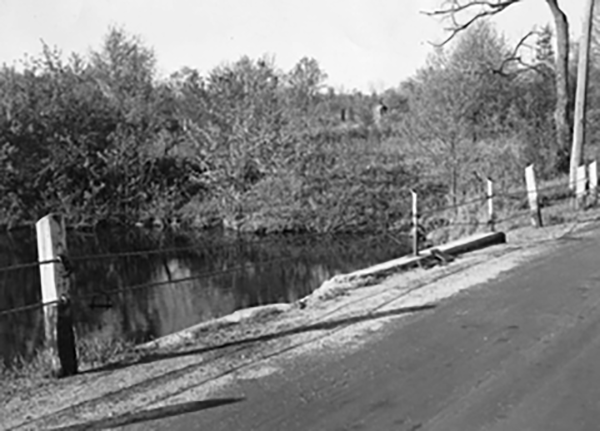
Mill pond at Center Street and Wolcott Road 1947. Where Pat's IGA is today.
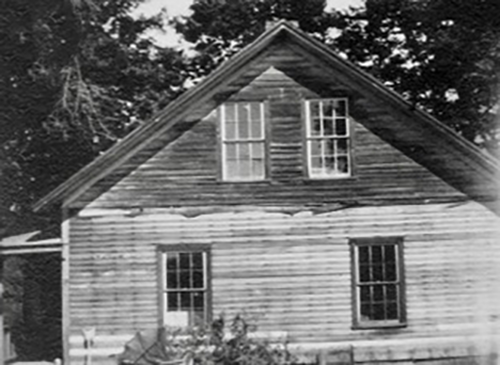
James Thomas house 1932.
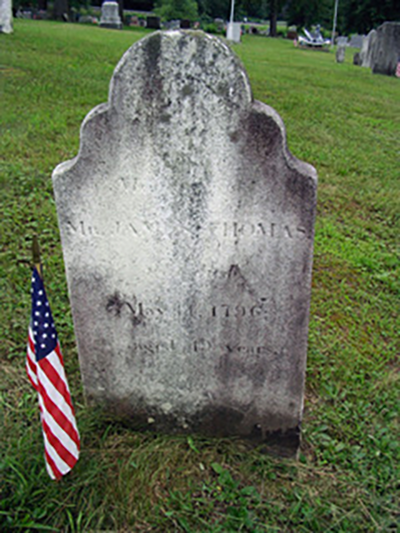
Thomas tombstone - Edgewood Cemetery.
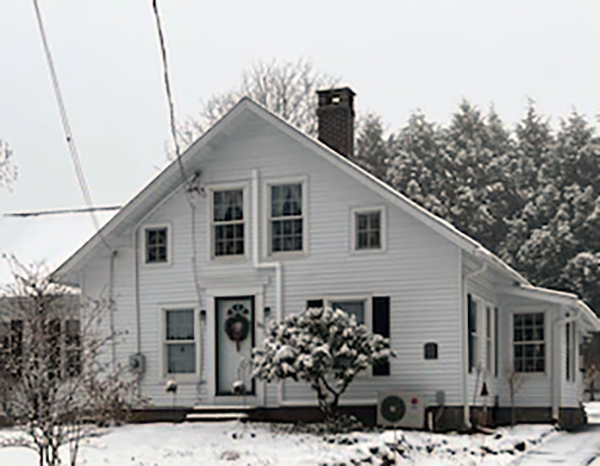
Thomas House 2025 located at 36 Peterson Lane.
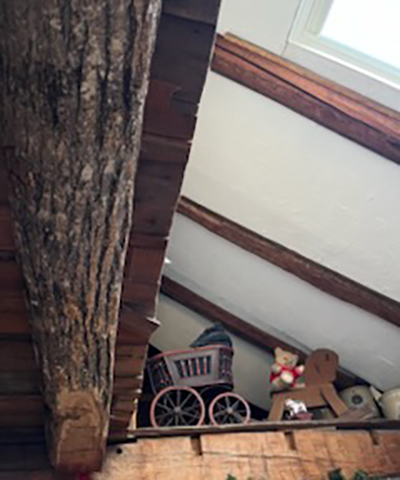
View of the 250-year-old beams found in the Thomas post and beam house.
To view past installments of the Historical Society News, click here.
|